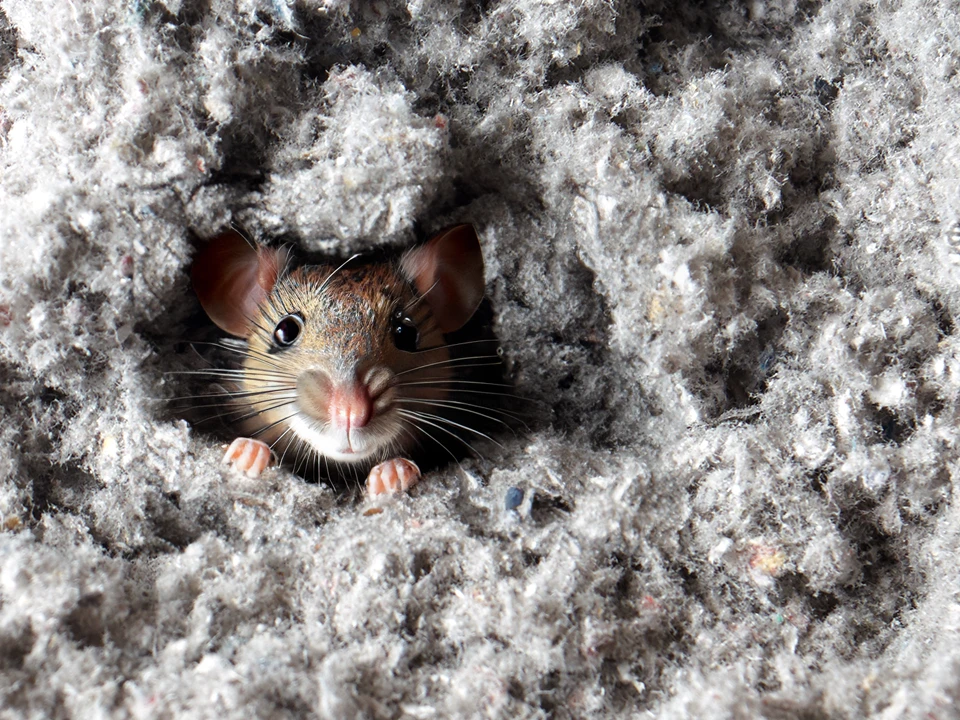
Usually yes, if they were nesting up there. A rat that crossed your attic on the way somewhere else leaves droppings you can pick up. A rat that lived in the insulation for a season leaves urine that soaked into it, and that does not dry out, air out or wipe off. At that point the insulation is the thing that has to come out.
What decides it is how long they were above you and how far they ranged. Roof rats come in high, off the mature street trees through Bixby Knolls, Los Altos and California Heights, which is why people here usually hear something overhead before they find anything at floor level. There is more on how rats and mice get into Long Beach houses on our city page.
So the honest answer is that some attics need a clean-out and some need a bag and a vacuum-free wipe-down. Here is how to tell which one you have, what a complete job includes, and what moves the price.
In Long Beach, Seal Beach, Huntington Beach, Torrance or Newport Beach? Dr. Pest works these cities every week. Call (562) 488-7455 for a free inspection and a written quote before any work starts, or see the city we cover nearest you.
How do you know the insulation is contaminated and not just dirty?
You look for travel, not for mess. Rodents use the same routes night after night, so the tells are linear. Flattened runs pressed through blown-in insulation, usually following the top plate of a wall or the line of a rafter. Droppings gathered in drifts at the ends of those runs rather than scattered evenly. Dark rub marks where a body has squeezed past a joist. Shredded paper, palm fiber or chewed insulation pulled into a hollow the size of a grapefruit.
Smell is the other tell. A musky ammonia note that gets stronger when the air handler kicks on points at material sitting in or near the ducting, which matters in the post-war tracts out toward El Dorado Park, where ducting often runs through the attic. And if the house sits near the water, at Naples or along Alamitos Bay, have the subfloor looked at as well as the attic. A raised foundation gives them a second place to nest.
Does the whole attic have to come out?
Often not. If the activity stayed in one corner near the entry point and the runs are short, the affected sections come out and the rest stays. Full removal is for attics where the runs cross the whole ceiling plane, where droppings are general rather than concentrated, or where the insulation has been compressed and chewed to the point it has stopped working as insulation anyway.
A lot of older Long Beach houses land in the second group for a reason that has nothing to do with the rats. The pre-war Craftsman and Spanish homes through Belmont Heights, Rose Park and the Craftsman Village district have low, tight attics with original material that has been topped up over the decades rather than replaced. Once something has been living in a layered attic like that, sorting the good from the ruined costs more than taking it all.
What has to happen before anything gets cleaned?
The sealing. This is the part people get backwards, and it is expensive to get backwards.
Clean an attic that still has open entry points and you have paid to prepare a nest site. The order that holds is inspection first, in the attic and the subfloor, because the way in is almost never where the noise is. Then exclusion, which means screening the vents and closing the gaps at the roofline junctions, the utility penetrations and the eaves. Then trapping until activity reads zero. Only then does the insulation come out. Our rodent exclusion work, which is the sealing half of the job, is what makes the clean-out last, and the fuller picture of how we approach rats and mice is on the rodent control page.
What does a complete attic clean-out include?
Ask any company you call to walk you through these, and be wary of a quote that skips one:
- A written inspection that names the entry points it found, not just a total.
- Exclusion completed and verified before removal begins.
- Trapping run to zero activity, not to a fixed number of visits.
- Soiled insulation bagged in the attic and carried out sealed, not raked toward the hatch.
- A disinfectant applied to the deck and framing, with time left to dwell before wiping.
- Insulation replaced to the depth the house actually calls for, and the work put in writing.
On the health side, follow the public guidance rather than instinct. The CDC advises against vacuuming or sweeping rodent urine, droppings or nesting material, because that is what puts particles into the air you are standing in. It recommends ventilating the space for 30 minutes first, gloves at minimum, spraying rather than brushing, and letting disinfectant sit about five minutes before wiping up with paper towels. That guidance is the reason a proper crew does not show up with a shop vac.
What drives the cost?
We do not publish figures, because a number written before anyone has been in your attic is a guess. What we can tell you is what actually moves it.
Attic access and clearance is the biggest single factor. A low pre-war attic off Broadway where a technician is working on their stomach between rafters takes far longer per square foot than a walk-height space in a 1960s tract. After that: the square footage affected, whether ducting is involved, how many entry points there are to close, the number of trips to carry material out of a house with no side access, and disposal. Alley-access properties downtown and through Belmont Shore often come in lower on that last one simply because the truck can get close.
Dr. Pest inspects first and gives you the scope in writing before any work starts, and the inspection is free. Our work is backed by a 100% satisfaction guarantee: if pests return, so do we, at no cost.
Can you do it yourself?
You can. People do. The two places it goes wrong are protective equipment and sequence. Doing the clean-out before the roofline is sealed means doing it twice, and a household vacuum in a contaminated attic is the one step the public health guidance specifically tells you not to take. If the affected area is small, the attic is easy to stand in and you have already closed the way in, it is a reasonable weekend. If you are crawling through a 1920s attic in the dark with a torch in your teeth, get a quote.
When should you have it looked at?
As soon as the noise stops being occasional. Rodents do not move out on their own, and every week they stay is more material to remove later. If you have already had someone trap and the sound came back, that is a sealing problem, not a trapping problem, and the attic is worth opening up.
Dr. Pest works Long Beach every week, out of an office on Quincy Ave, along with Seal Beach, Huntington Beach, Torrance and Newport Beach. We also cover the rest of the pest control work we do across Long Beach. Call (562) 488-7455 and we will get someone out to look in the attic and the subfloor, and you will have the scope and the price in writing before anyone starts.
Leave a Reply